Showing posts with label Classics. Show all posts

Tuesday, 2 September 2014

Atalanta

Details of the Atalanta (left), showing at the International Concours of Elegance at Hampton Court Palace this weekend, are sketchy. It is unlikely to be as avant garde as its predecessor. Only around 20 were made between 1937 and 1939 but it broke new ground as the first British production car with all-independent suspension. Claimed to “maintain true fidelity to its predecessor and offer a unique motoring experience, the new Atalanta exhibits the style of Silver Screen glamour combined with developments from 75 years of motoring evolution.”

However to match the cars backed by racing drivers Peter Whitehead and Denis Poore, besides novel Hiduminium and Electron all-independent suspension it should have adjustable dampers, hydraulic brakes, two spark plugs with at least three valves per cylinder, and a selectable supercharger. We are told that 90% of the new components are designed and engineered directly by Atalanta, including castings, forgings and fabrications and the body is traditional aluminium-over-ash coachbuilt. But originals had the option of an electric Cotal epicyclic gearbox, a sort of early semi-automatic, or a 3-speed dual overdrive Warner.
The first Atalanta engines were designed by Albert Gough, late of Frazer Nash, and they had more than the feeble 60bhp of the 1934 chain-driven sports cars. There was a choice of 1½litre 78bhp or 2litre 98bhp, but before many were made Atalanta had them redesigned. AC Bertelli of Aston Martin went back to 2-valve heads with superchargers to choice from Centric or Arnott. In 1938 a 4.3litre V12 Lincoln Zephyr engine of 112bhp provided a decent turn of speed. The Zephyr was not much more than a side-valve Ford V8 with four more cylinders, but it improved acceleration. Top speed either way was about 90mph; perhaps more than enough because the independent rear with horizontal coil springs was said to produce curious handling although reducing wheelspin. (Autocar 1937 artwork above right)

Atalanta managing director Martyn Corfield, who has experience in car restoring: “Staying true to the original Atalanta design principles, we have enhanced the positive and enjoyable characteristics of vintage motoring in a style that is relevant and exciting today. As in the 1930s, Atalanta Motors provides the opportunity to commission an individual driving machine to exacting requirements. The new sports car offers an exhilarating drive with assured handling and a supremely comfortable ride.”

Visitors to the Concours of Elegance will be able to see a prototype of the new car as well as a 1937 Atalanta, one of seven survivors, owned by Matthew Le Breton, which won Best in Show at the 2007 Cartier et Luxe Concours at Goodwood.

“Atalanta’s presence at this year’s Concours affords a rare opportunity to see and commission a piece of motoring heritage.” The originals were expensive at £582. Commissioning a new one will be a bit more.

Thursday, 28 August 2014

EOIN YOUNG

Motor racing threw up some notable writers. SCH Davis, Bentley Boy of the 1920, sports editor of The Autocar over 40 years. Rodney Walkerley, his urbane, witty opposite number at The Motor. Bill Boddy, longest serving editor of Motor Sport; Denis Jenkinson its Continental Correspondent and co-pilot with Moss in the Mille Miglia. Gregor Grant, Autosport founder who never let the facts stand in the way of a good story. The engaging American Henry B Manney III, as funny in life as in print. Peter Garnier, Davis’s astute successor, so close to his subject they made him secretary of the Grand Prix Drivers’ Association. Innes Ireland, amazingly articulate and perceptive at Autocar, paving the way for television punditry from James Hunt, Martin Brundle and David Coulthard. Elegant technicians, Laurence Pomeroy son of the gifted Vauxhall designer and LJK Setright, whose classical quotations were almost as good as Pom’s but whose engineering was no match. We had the well-informed David Phipps and nowadays Alan Henry and spirited prose from Maurice Hamilton and Peter Windsor.
Yet none of them were quite a match for the best news-gatherer the sport ever had. Ill-health has consigned Eoin Young to a hospice in his native New Zealand but his From The Grid column in Autocar was obligatory for anybody in the business or out of it. Well-connected ever since he came to Europe and worked with Bruce McLaren in 1961 Eoin had the biggest scoops. His was the best-informed commentary, nobody knew as much as he, nobody spilled as many secrets and above all his writing told readers he was the insider’s insider. It didn’t matter if you were an outsider, Eoin had a way of gaining your confidence.
Eoin Young knew who was going to drive for whom next year – sometimes before they did. He knew who was up-and-coming and who was going down-and-out. He would take notes and print it yet I don’t suppose he ever broke a single confidence. If you told Eoin anything he would take it that you were, in effect, telling the world. He was only the means to the printed page. His veracity seemed to encourage his informants, who told him things they’d confide to no-one else.
Maybe a little rancorous in later years - his personal life was turbulent – Eoin was competitive and neither gave nor expected anything less than determined bargaining in books. His Autocar columns will be a priceless resource to motor racing historians, his books perhaps less so. They were variable; he seemed to grow bored with research or writing at length or in depth. His forensic skills were best in his brief, punchy impertinent style.


Tuesday, 26 August 2014

Spa-Sofia-Liège: A motoring adventure

Fifty years ago this week I set off from Spa in Belgium to report the last Spa-Sofia-Liège Rally. The Marathon de la Route was organised by the Royal Motor Union of Liège, whose M Garot enjoyed his reputation for organising the toughest rally in the world. Started in 1931 as the Liège-Rome-Liège, it had been to various turning points, settling in 1964 on Bulgaria then well behind the Iron Curtain. Only a handful of cars ever made it to the finish.

I set off from Spa in pursuit. The Motor sent junior staff on important assignments safe in the knowledge that they were accompanied by veteran photographers. They, like George Moore who came with me, had done it all before. We could pitch up at a Yugoslav B&B; George would know the language, how much we’d be charged and probably the proprietor’s name. He introduced me to drivers, team managers, other journalists and helped me across the tripwires of providing a true and accurate account, without frightening the horses.

You would be meeting them again on the RAC and then the Monte as well as next year’s Alpine. They seemed to run out of Presse plates so I ran as an Officiel.

A Ford Corsair GT was unlikely as a means of keeping up with works Austin-Healey 3000s and 1962 European Rally Champion Eugen Böhringer, but it was the only car spare. It could manage 95mph on a good day and reach 60 inside 13sec. In the interests of science I made the brakes fade on the downside of an alp; I had heard about brake fade but never really experienced it so when George dozed off I got the brake fluid boiling. The 9in front discs (there were drums at the back) were probably aglow. I left off before it got dangerous.

We kept up with the rally for 3,000 miles. George knew the shortcuts when it dashed off into the mountains. Memorably this was the event on which Logan Morrison and Johnstone Syer, whom I knew from Scottish rallies, retired their works Rover 2000 when Blomquist’s Volks-wagen overturned. The driver was unconscious and nobody, not even a VW team-mate, had stopped so Logan's opportunity for glory was lost.

This was also the rally on which BMC competitions manager Stuart Turner could not conceal his delight. He had not only scored the second win with a big Healey but also “We broke the sound barrier - we got a Mini to the finish of the Liège.”

Title of the report? The Beatles had just made “A Hard Day’s Night.” Aaltonen’s car (below left) was sold by Bonhams in 2005 for £100,500. I drove another works car in 1966, reporting on it in Safety Fast magazine and again in Sports Car Classics Vol 1. Amazon £3.08. After a number of countries decided rallies at such speeds dangerous, they refused the Royal Motor Union permission to continue it. The Marathon de la Route became a track event on the Nürburgring. The Liège-Rome-Liège reappeared only as a touring classic.

The Motor, week ending September 5 1964

A hard (four) days’ night. Austin-Healey win an even faster Spa-Sofia-Liège rally. Report by Eric Dymock pictures by George Moore.

“The Liège has been getting slack; there were twenty five finishers last year and eighteen the year before.” In 1961 there were eight, thirteen in 1960 and fourteen the year before that. M. Garot wants it back to about eight and this year he very nearly got his wish until an alteration in plans put several cars back into the running. But he tried.
After the finish, John Sprinzel said, “This year we did about a day and a half's route in a day.” The pace was much, much hotter with average speeds of 50 and 60 mph over rough, rocky roads where such a schedule is just not possible. The 1964 Spa-Sofia-Liège was run in hot weather over roads little rougher than before but at a cracking, damaging pace for four days and nights of the most intensive high-speed motoring in the world.

RaunoAaltonen, the Finnish speedboat racer and Tony Ambrose, Hampshire shopkeeper, won with a works Austin-Healey 3000. Saabs driven by Erik Carlsson and Pat Moss-Carlsson were second and fourth, and Eugene Böhringer took third place in a 230SL Mercedes-Benz after two successive wins in 1962 and 1963. For finishing in three consecutive years, Böhringer wins a Gold Cup in company, this year, with Paul Colteloni (Citroën), Francis Charlier (Volvo) and Bill Bengry (Rover two years, now Sunbeam).

Citroën were the only manufacturer with a team left intact (they had entered three) and none of the club teams finished with more than two runners. Forty-two tired, dusty people steered twenty-one tired, dusty, battered motor¬cars into the finish on Saturday, survivors of the hundred or so gleaming machines which left Belgium late the previous Tuesday. Three Alfa Romeos were entered; none finished. Thirteen Citroëns were entered; only four sighed and wheezed into the last control. Out of eighteen Fords only three survived and the entire Triumph, Renault and Rover teams were. wiped out. Volks¬wagens, usually stayers on rough courses, started with seven, finished with one; even the might of Mercedes was reduced from five to two, although two more struggled on till the very last night.

The scrutineering on Tuesday morning was a leisurely affair, and nothing caused much trouble. As last year, there was some carping over lights, the officials preferring paired spot lamps and reversing lights worked by the gear 1ever and not a switch. So while they appeared not to notice Perspex windows and plastic body panels, they banned an odd fog light. Drivers solemnly removed the bulbs, the officials daubed paint here and there, stamped the car and it was over -¬ except for the replacement of the bulbs just down the road. All very casual. One British team chief wryly remarked “You could drive up here in a supercharged plastic van and they'd pass it”.

The cars were despatched from Liège on Tuesday evening (with the exception of eight non-starters including Trautmann (Lancia) and Feret’s Renault) in quick, three-minute batches of three to spend the night on the Autobahn through Germany, arriving just after first light at Neu Ulm, beyond Stuttgart. The section was neutralized for time, but it was here that Rover's misfortunes began. Anne Hall handed over the 2000 to co-driver Denise McCluggage who, while Anne slept, wrong-slotted down the Stuttgart Auto¬bahn and went 100 kilometres before she realized her mistake. The hour’s lateness guillotine swept down on the Rover before the event was properly under way.

Through Austria, and into northern Italy over the Passo di Resia to the Passo di Xomo, the rally began in earnest. High average speeds were imposed over the dusty, narrow roads, which climbed close to the peaks in everlasting hairpin bends. And the retirements began. The Boyd/Crawford Humber went out before the Alps, so did the Michael Nesbitt/Sheila Aldersmith Mini-Cooper, at Lindau with a broken fan pulley. High in the Alps, at Tresche-Conca the pace and the sun were both hot and tourists coming the other way, through the control at Enego were picking their .way carefully. But enthusiastic Italian policemen waved the rally cars through villages and the popu¬lation joined in urging the drivers to greater things. If the rally was momentarily unpopular with other cars actually on the road, bystanders in those high-altitude villages loved it. (Below: My 1966 works car on test)
By Villa Dont, just before the Yugoslav border, the WiIlcox-Smith Saab retired, the Xomo had claimed an Italian-entered Maserati, and some really punishing sections began. By the time the rally had entered Yugoslavia and passed through Bled, Col and Carrefour Ogulin in the early hours of Thursday morning the pace was telling very seriously. Ford's troubles began with the Richards/David Cortina going out, followed by the Ray/Hatchett Cortina. The Martin Hurst/Bateman Rover 3-litre retired after a stone damaged the fan, which disintegrated through the radiator. The car lost its water and that was that. The Belgian Harris/Gaban Lancia Flaminia, de Lageneste/du Genestou in their works Citroën, the Wilson/Smith Renault, and the Slotemaker/Gorris Daf, were among the 25 cars this 150-mile stretch of rocky, dusty road claimed. Timo Makinen had persistent tyre trouble; six punctures in quick succession losing him so much time he had to retire and another works Citroën went out with clutch trouble. Both American Ford Mustangs retired on this stretch, one overturned.

Novi, on the coast, Zagreb and the autoput to Belgrade then took their toll. The weather remained hot, wearing out tyres and brakes fast, as well as the drivers. The high speeds on the autoput overheated the gearboxes on the heavily undershielded works M.G. Bs of Pauline Mayman/Valerie Domleo and Julian Vernaeve/David Hiam; both broke before Belgrade. The Clark/Culcheth Rover 2000 stopped with engine trouble and the Marang/”Ponti” works Citroën retired. Many, many cars were now running very late and just before the Bulgarian border the organizers intro¬duced a change of route. This added a loop of fairly easy road about 90 kilo¬metres long, with which went a two-hour time allowance. Whether M. Garot did this to give the drivers some breathing space or not, this was in effect what happened and probably more cars reached the finish as a result. Certainly, the original route was passable (some used it) and service crews at Sofia, the turning point, were glad of the extra few minutes to restore the battered cars to something nearer rallyworthiness.

But Bulgaria claimed its victims too. Renault lost two R8s and Austin-Healey the Paddy Hopkirk/Henry Liddon car, which broke down also with gearbox trouble. Honda, after their tragic Liège last year, had entered one car with a Belgian/Japanese crew, but it, too retired when it was hit by a lorry. The Seigle-Morris/Nash Ford Corsair went out at Sofia and so did one of the big rear-engined Czechoslovac Tatras.

The survivors now attacked one of the roughest parts of the entire rally. Back into Yugoslavia through Kursumlija to Titograd and Stolac. The King/Marlow Ford Cortina (a private entry which usually gets further than most) went out near Titograd after the electrics failed and the car had to be push started at every control. A puncture when the time allowance was running out was the final blow. The Sprinzel/Donnegan Cortina's front suspension was getting tattered by now and needed frequent attention. Help was recruited from the most unlikely sources to weld and rebuild for a harrowing but apparently hilarious limp to the finish.

The Taylor/Melia works Cortina finished, its rally on the same road, or rather off the same road too badly damaged to continue. SimiIarly the Elford/Stone works Cortina crashed with its wheeIs in the air and the James/ Hughes Rover 3-litre stopped against the rocks, thus sacrificing two gold cups. All the accidents were without serious injury to the drivers.

The Gendebien/Demortier Citroën re¬tired less spectacularly but just as effectively with distributor trouble, then it was the turn of the works Triumph 2000s to fail. They had been going very strongly indeed up to Stolac and Split on the return through Yugoslavia, especially the Terry Hunter/Geoff Mabbs car. The Fidler/Grimshaw and the Thuner/Gretener cars went out first, then the third at Split, all within a short dis¬tance of one another with the rear suspension breaking loose. Logan Morrison/Johnstone Syer retired their works Rover 2000 when they went to the help of the Blomquist/Nilsson Volks¬wagen which had overturned. The driver was unconscious and no other help was available (nobody else, not even a VW team-mate had stopped) so Logan's chances went with another car's acci¬dent. The last Rover (the Cuff/Baguley 3-litre) retired, running out of time after hitting a wall near Split. The Toivonen Volkswagen went out with a broken gearbox.

At Obrovac, the rally had spread itself out over many miles of road. The sur¬vivors who were motoring strongest in the intense heat were being led by the Aaltonen/Ambrose Austin-Healey and Böhringer/Kaiser Mercedes-Benz 230SL, bent now and losing oil. The two Saabs were crackling their fierce exhaust notes through the tiny Yugoslav villages watched by wondering peasants and only Ewy Rosquist looked cool at the wheel of the Mercedes-Benz 220SE she co-drove with Schiek, The long, straggling field drove up the twisty, spectacular, but well¬ surfaced coast road beside the inviting Adriatic and back into the Italian Alps for the second time and the final, gruelling night’s drive. Further casualties were few; there weren’t many cars left to drop out and those who had motored thus far were very determined indeed. A Belgian Mercedes-Benz 220SE failed at Bienno and the similar works car of Kreder and Kling at Trafoi.

The finish was almost an anti-climax. Large crowds and flowers greeted the dusty, battered, straggling cars as they creaked into Spa before the final proces¬sion to the Royal Motor Union premises in Liège itself. Past winner Pat Moss and her pert, pretty 19-year-old Swedish co¬driver Elizabeth Nystrom got a special cheer. The winning Austin-Healey looked little the worse for its ordeal and so did the Saabs. Böhringer's Mercedes had lost some front lights. The brave La Trobe/Skeffington Humber Super Snipe whose, performance had been staggering had a dented door; the big, yellow Tatra V8 which had done equally well (such big cars must have been a handful) was similarly bent. The Alan Allard/Mackies Cortina was scraped on all four corners, after an off-the-road excursion on its roof, and the Sprinzel/Donnegan Cortina limped into the finish using up so much of its time allowance that all the crowds had gone home and no one saw its bruises.

What pleased B.M.C. team manager Stuart Turner almost as much as his out¬right Austin-Healey win? “We broke the sound barrier - we got a Mini to the finish of the Liège.” The Wadsworth/Wood Morris-Cooper was, in the final pare fermé in Belgium, albeit with heavy penalties, but after some 3,100 of the world’s toughest, roughest, fastest miles.


Tuesday, 22 July 2014

A new Auto Union

Germany’s Manager Magazin asserts that VW might buy Fiat-Chrysler. Ferdinand Piëch wants to re-create Auto Union and combine the VW brands Audi, SEAT and Skoda with classics like Alfa Romeo, Bentley, Bugatti, Lamborghini, Maserati, and Porsche. Along with Fiat and Chrysler it could make over 14 million cars a year, consigning Toyota and General Motors with about 10 million into second place.

In the 1930s four rings signified the creation of the first Auto Union, the amalgamation of the motor industry in Saxony. DKW, Horch, Wanderer and Audi joined up to weather financial storms following the Great Depression and face intervention from the emerging Third Reich. The State Bank of Saxony, the Allgemeine Deutsche Credit Anstalt (ADCA) and the Commerzbank of Berlin were midwives at the birth of the Auto Union.
Wanderer was the oldest, established in 1885 at Chemnitz. In 1899 August Horch set up at Cologne-Ehrenfeld, moved in 1902 to Plauen in the Vogtland, then in 1904 as a public company eastwards to Zwickau in Saxony. Third ring DKW also had roots in Chemnitz from 1904 when Danish entrepreneur, Jörgen Skafte Rasmussen established Rasmussen & Ernst GmbH in an empty textile works at Zschopau in the Erzgebirge. In 1914, as the Zschopauer Maschinenfabrik J S Rasmussen, it did military work, experimenting with a large, and as it turned out unwieldy, steam vehicle the Dampf Kraft Wagen (DKW - Steam-Power-Vehicle).

DKW persevered with motorcycles, making a primitive car in 1928, then at the 1931 Berlin motor show made a breakthrough with the first front wheel drive production car three years ahead of Citroën. FWD was novel, it was cheap, and DKW was good at it. Innovation did not bring prosperity however, and DKW was obliged to take a shareholding in Audi, making Rasmussen chairman. But by 1932 car sales in Germany had halved and DKW suffered from Rasmussen's expansionism. To make things worse, the Hitler regime planned a state-sponsored car to go on sale to the German Volk at a seemingly impossible price to savers of political tokens.
Amalgamation was complicated and it took nine months to agree terms and acquire funds. Headquarters were at Chemnitz, the Zschopauer Motorenwerke raised its share capital from 4.5 million Reichsmarks to 14.5 million and the new Auto Union AG bought the fourth ring, Wanderer, leasing its factories.

DKW's contribution of share capital was Rm10 million, Horch brought Rm500,000, Audi Rm2,500,000, and Wanderer Rm15,730,000. The new combine had a staff of 4,500 and factories at Zschopau making motorcycles and 2-stroke engines, Zwickau (cars), Berlin-Spandau (wooden body frames) and Siegmar (cars and steel bodies). Auto Union was a major player in the German motor industry alongside Adler, BMW, Opel, Daimler-Benz, and Ford. Meanwhile the cause of all the angst, the Volkswagen, was slow making its appearance.
Ferdinand Porsche’s consultancy made a submission to the Ministry of Traffic in Berlin for a car selling for Rm1500, with a fuel consumption of 8l/100 kms (35 mpg), a top speed of 100 kph (62 mph) and a weight of 650 kg (1433 lbs). Hitler and Porsche met in April 1934, at the Kaiserhof Hotel in Berlin, together with Jakob Werlin, Mercedes-Benz dealer in Munich and an early member of the Nazi Party. Werlin carried weight, joined the Mercedes-Benz supervisory board, and went on to be inspector-general of the industry.

Hitler sanctioned the VW provided it could cruise the new autobahns at 100kph, obtain a fuel consumption of 7l/100 kms (40 mpg) and sell for Rm990. A contract was drawn up under which Rm200,000 was set aside for a prototype and a production run of 50,000. The effect on the established Saxony car makers was profound but in 1935 Volkswagen was inaugurated. State intervention had been inevitable and the Auto Union’s marques Horch, Audi, Wanderer and DKW were broadly complementary. Horch made premium big saloons and tourers, Audi was distinctly middle-class. Wanderer had a solid array of good family cars and DKW lively cheap two-stroke economy models.
An urgent task was to forge the group’s identity and it took up a German state subsidy to build a 16-cylinder car designed by Professor Porsche, inaugurating a momentous period of grand prix motor racing. Mercedes-Benz and Auto Union overwhelmed all opposition in a demonstration of German technical pre-eminence, a triumph for the Reich’s propaganda machine under Dr Joseph Goebbels.

Now Automotive News Europe reports: "The simple deal logic is straightforward," London-based analyst Arndt Ellinghorst of ISI Group wrote in a note to investors. "Chrysler - better Jeep and Dodge - could fix VW's US problems; Alfa could replace the ailing Seat brand; Fiat Europe is basically the 500 product family plus LCVs. Latin America could be sold, potentially to a Chinese buyer."
Both Piëch and Martin Winterkorn, VW chief executive, are on record as showing interest in Alfa Romeo. VW had $24 billion in cash to play with at the end of March, so a takeover would be manageable. Everybody denies any such thing but Piëch, the obsessive and brilliantly successful 77 year old grandson of Ferdinand Porsche gets his way more often than he doesn’t. If VW bought the 150-strong Agnelli-Elkann dynasty's 30 percent controlling stake in Fiat-Chrysler it could be $5 billion or $6 billion richer and even keep Ferrari to bring a regular $475 million pocket money every year.

Top: Mid-engined masterpieces, Auto Union racing cars by Dr Porsche.

Audi adopted Auto Union’s four rings.

Number 1 surmounts the bonnet of an Audi Front.

Horch made some spectacular cars

DKW Sonderklasse. Front wheel drive, 2-stroke and one of my first ever test cars, borrowed from the factory in Düsseldorf in 1956. My first drive at the Nürburgring.

Workaday Wanderer W24 with Auto Union rings

Wednesday, 16 July 2014

Classic Motoring Photographs

What a lot we owe Bill Brunell. A professional photographer in the glass plate era of the 1920s and 1930s, he left a unique record of crisp, beautifully detailed pictures of a motoring age long gone. The Motoring Picture Library has added 5,000 images from the National Motor Museum’s Bill Brunell Photographic Collection to its website

The model with her head through the sunroof of the Singer 8 Junior is most likely Brunell’s daughter, Kitty, who features in many of the photographs, and drove in the Monte Carlo Rally in 1928 with her father in his Singer Junior. They started from John o’Groats but retired. She competed in 1929 driving a Talbot 14/45 for which she designed the body. It became known as the Sportsman’s Coupe and Talbot was so impressed that it built another car for her for 1930, known as ‘Kitty II’. She married veteran competitor Ken Hutchinson.

Bill Brunell was co-driver to the Hon Victor Bruce in 1926 when they became the first Englishmen to win the Monte Carlo Rally and worked for the Ministry of Information and secret intelligence in the First World War.
Motoring Picture Library Manager, Jon Day said: “Brunell’s photography is an evocative reminder of the golden age of British motoring, capturing perfectly the mood and spirit of the era. From street and social scenes to events, trials and rallies throughout Great Britain and Europe, Brunell’s images are an important historical record with artistic merit in their own right.It has taken NMM staff and volunteers over three years to digitise the glass plate negatives. The originals have subsequently been re-packaged and archived.The Beaulieu Motoring Picture Library with an archive of over a million images, is one of the most comprehensive sources of motoring photographs in the world. It supplies pictures to enthusiasts and commercially to publishing, broadcasting and advertising.

The works racing Austin Seven team (above) of Bert Hadley and Charles Goodacre at Brooklands with Kay Petre in car nearest Brunell’s camera.

Sunday, 22 June 2014

1928 MG 18/80 Mk II

A wider track and a 4-speed gearbox alone would not have justified the substantial price of the Mark II 18/80, on Classic MG digital at £7.56. Detailing was carefully done, aluminium components were polished, engines carefully balanced, and the three-ringed aluminium pistons ground and lapped. An automatic Tecalemit chassis lubrication system actuated by the car’s movement extended servicing intervals to 3000miles (4828kms), extremely generous for the time. The Mark II did not replace the Mark I straight away; it had never been a fast seller so the two were put on the market apparently alongside one another. Mark I Speed Models were eligible for a Brooklands 80mph (128.7kph) certificate for 12 guineas a time, cynics suggesting this was to cover a mechanic’s time spent making sure it would actually manage it. Triplex safety glass and a Dewandre vacuum brake servo were added but there was a certain amount of equivocation over the additional gear. It was described as a “silent third”, a fashionable reassurance in an era of loudly whining gears, or alternatively “twin top”, a tacit admission there was perhaps not much difference between ratios of 1: 1 and 1.306: 1. Extra equipment and a more substantial chassis carried a weight penalty of some 3cwt (152.4kg). Mark I production petered out in July 1931, Mark IIs in summer 1933, but eclipsed by the success of small MGs, some 18/80s were not sold until 1934.
BODY Saloon 4-door 4-seat; Sports 2-door 2-seats; Salonette 2-door 4-seats; Open Tourer 4-door 4-seats; chassis weight 20.5cwt (1041.4kg), Tourer 27cwt (1371.6kg), saloon 29.25cwt (1485.9kg) Speed Model with fabric body, staggered doors, left front passenger and right rear 22.75cwt (1155.7kg). ENGINE 6-cylinders; in-line; 69mm x 110mm, 2468cc; compr 5.75: 1; 60bhp (44.7kW) @ 3200rpm; 24.3bhp (18.1kW)/ l. ENGINE STRUCTURE Duplex gear and chain-driven ohc; cast iron block, detachable cylinder head, pent-roof machined combustion chambers; two horizontal double float SU carburettors; chain drive to distributor, waterpump, and dynamo, skew drive to oil pump; coil ignition; 4-bearing counterbalanced crankshaft. TRANSMISSION Rear wheel drive; five-plate cork insert clutch; 4-speed non-synchromesh gearbox with remote control; torque tube drive; spiral bevel final drive 4.27: 1. CHASSIS DETAILS Steel channel-section cross-braced upswept front and rear; upward-inclined half-elliptic leaf springs front-shackled 39in (99cm) front and 50in (127cm) rear; rear springs shackled both ends and carried outside frame; Silentbloc shackle bearings; single arm Hartford Duplex dampers; 14in (35.5cm) finned cable-operated brakes; Marles steering ; 12gal (54.5l) tank; 2gal (9.1l) reserve ; 19 x 5 Dunlop Fort tyres; Rudge-Whitworth centre lock wire wheels. DIMENSIONS Wheelbase 114in (289.6cm); track 52in (132.1cm); turning circle 37ft 6in (11.4m); ground clearance 8in (20.3cm); length 156in (396.2cm); width 64in (162.6cm ); height 64.5in (163.8cm), Tourer, 67in (170.2cm). PERFORMANCE Max speed 80mph (128.7kph); 20.5mph (33kph)/ 1000rpm; fuel consumption 18mpg (15.7l/ 100km). PRICE chassis only £ 550, 2-seater £ 625, Tourer £ 630, Salonette £ 655 (fabric body and Triplex glass), Saloon £ 670 (coachbuilt)

Tuesday, 17 June 2014

Classic MG

Introducing both Midget and 18/80 at the 1928 motor show was a turning point for MG. Cecil Kimber insisted on some firm orders at Olympia before committing to a big 2½litre 6-cylinder as the Edmund Road factory was made ready. A prototype 18/80 went on show with encouraging results, and the while the new car was not quite in the soon-to-be-vacated sporting territory of Bentley, it was more grown-up than most MGs. First to have the distinctive upright MG radiator shape that did so much to establish the identity of classic MGs, it was also the first 6-cylinder even though it continued using lots of Morris Motors’ components. Morris-derived engines in MGs had tended to be basic and side-valve, until the acquisition of Wolseley, along with Frank Woollard a former colleague of Kimber’s, who was made works manager. Woollard encouraged adventurous designs with an overhead camshaft, regarded by William Morris as a needless extravagance. Parsimonious Morris disapproved of the expense and the engine was never a success in Morrises. The 18/80 was treasury rated at 17.9hp but never attained anything like the 80bhp (60kW) implied in the title. About 60bhp (44.7kW) was its best ever. Advertisements claimed it had the sports performance and luxurious ease of a Two Thousand Guinea creation, “truly a competitor for the contemporary Alvis and Lagonda”. It was certainly a notable MG of the Vintage period, commendably smooth with strong torque and a surprisingly compliant ride. MG designed the chassis with 6in deep channel section side members and box-section cross-bracing, together with the axles although the torque tube transmission was pure Morris. One curiosity was the “MG” cast into the bulkhead uprights. It was neither octagonal nor could it ever be seen, except when the bodywork was entirely removed. Classic MG digital edition £7.56
BODY Saloon 4-door 4-seat; Sports 2-door 2-seats; Salonette 2-door 4-seats; Open Tourer 4-door 4-seats; chassis weight 19cwt (965.2kg), 2-seater 23cwt (1168.4kg), saloon 25.75cwt (1308.1kg) ENGINE 6-cylinders; in-line; 69mm x 110mm, 2468cc; compr 5.75: 1; 60bhp (44.7kW) @ 3200rpm; 24.3bhp (18.1kW)/ l. ENGINE STRUCTURE Duplex gear and chain-driven overhead camshaft; cast iron block, detachable cylinder head with pent-roof machined combustion chambers; two horizontal SU carburettors; chain drive to distributor, water pump, and dynamo , skew drive to oil pump and distributor; coil ignition; 4-bearing counterbalanced crankshaft. TRANSMISSION Rear wheel drive; five-plate cork insert clutch; 3-speed non -synchromesh manual gearbox; torque tube drive; spiral bevel final drive 4.25: 1. CHASSIS DETAILS Steel channel-section cross-braced upswept front and rear; upward-inclined half-elliptic leaf springs front-shackled 34in (86cm) front, 50in (127cm) rear; single arm Hartford Duplex shock absorbers; Perrot-shaft 12in (30cm ) finned drum brakes early cars, later cable brakes, some with servos; Marles steering; 10gal (45.5l) fuel tank; 2gal (9.1l) reserve; 19 x 5 Dunlop Fort tyres; Rudge-Whitworth centre lock wire wheels. DIMENSIONS Wheelbase 114in (289.6cm ); track 48in (121.9cm); turning circle 43ft (13m); ground clearance 8in (20.3cm); length 156in (396.2cm); width 60in (152.4cm); eight 62.5in (158.7cm) 2-seater, 67in (170.2cm). PERFORMANCE Max speed 80mph (128.7kph); 20.5mph (33kph)/ 1000rpm; 0-60mph 30sec; fuel consumption 18mpg (15.7l/ 100km). PRICE chassis only £ 420, 2-seater £ 480, Tourer £ 485, Salonette £ 545, Saloon £ 555 PRODUCTION 500
(Above right)The late Roger Stanbury’s Mk I speed model, black and red, chassis 6737, engine JC10532 first registered 10 June 1931 as a University Motors demonstrator. The other is my Twin-Cam 2.0 M-16 engined MGB.

Friday, 13 June 2014

Bentley Brooklands

I didn’t mean to praise Bentley quite so faintly. I liked Bentleys, but I guess in 1992 I felt compelled to emphasise Brooklands, since there really wasn’t much that was new about the car. They had taken the turbo off the Eight, as recounted in The Complete Bentley available digitally for £12.31. After tax changes the price of the Brooklands came down to £87,500, making this essentially the entry-level Bentley. The press launch had been at Brooklands the previous month and they gave me a plaque to say I had driven a Bentley on such of the historic track that remained. This was before the developments that have taken place since, including the magnificent Mercedes-Benz World centre that opened in 2006. Perhaps I gave the Bentley less space that week because I wanted to highlight Saab’s research. I was coming round, even then, to the view that technology held the key to developments in driving we hadn’t even thought of. This was four years before Google had been invented and two decades away from driverless cars. You can now buy a Bentley Brooklands for the price of a well-used Mondeo.
BENTLEY INVOKES THE SPIRIT OF BROOKLANDS
It is not easy for an old aristocrat to recapture youthful vigour without losing some dignity. Bentley Brooklands has a fine alliterative ring for buyers tempted to a new non-turbocharged version of the old Bentley Eight at only £91,489. Its badges will be in traditional British racing green, to emphasise the connection with the track built by H F Locke King on his Weybridge estate in 1907. Brooklands was the cradle of motor racing, and Bentleys won stirring contests here, such as the six hours endurance race of 1929.
The 'Bentley Boys' wove themselves into the rich tapestry of Brooklands, dyed into the wool as indelibly as the Spitfires and Wellingtons created there by Vickers-Armstrong. Some Bentley Boys, like Clive Dunfee whose car topppled over the lip of the Members' Banking in 1932, lost their lives.
Brooklands is now a thriving industrial park. Gallaher's offices fill a gap in the Members' Banking, and one small corner is dedicated as a museum to halcyon days, when Locke King's estates extended not only to a large part of Surrey, but a good deal of Sussex as well.
The Bentley Brooklands is a magnificent anachronism, strong, quiet, powerful, and furnished in impeccable taste. Burr walnut, and deep Wilton carpet with tailored overmats give the interior the feel and the aroma of luxury. The loudest sound is not the clock - quartz movements no longer tick - but the faint creaking of the Connolly leather on the sumptuous upholstery. The huge 6.7litre V8 engine rumbles under the long bonnet, rejuvenated with the latest electronic technology, but still devoutly middle-aged. It is an imposing car, introduced just as Rolls-Royce and Bentley sales show signs of a recovery in Scotland and the North of England.

Wednesday, 11 June 2014

Rufus J Flywheel

It has taken me a long time to read Rufus J Flywheel on car names 19 January 2012 if you must know. He meditates, if that is the word for someone with a monicker that smacks of casually made up, on names. How easily the Dacia Lodgy could become Dodgy. Volkswagen’s Sharan Carat was close to Sharon Carrot and Mitsubishi’s Carisma didn’t have much.
Nothing’s new. Does he not remember Singer Vague and Humber Septic? Hillman Scavenger, Ford Crappi, Cretin (Cortina), Angular and Coarser (Corsair), or should Coarser be a Vauxhall? Rolls-Royce’s first idea for the Silver Shadow was Silver Mist until somebody told them Mist in German was something like MR2 in French.
CARkeys is a treasure-house. Well-written, well presented, up-to-date it has obscure material seldom found elsewhere, like David Finlay’s feature on a BMW based on the 1940 Mille Miglia 328. Shown as a Concept at scrutineering for the 2006 Mille Miglia, it was a bit like the real thing I drove in 1992 (left). I had it on good authority that the replica was a serious project at a time when quirky “future classics” were fetching silly prices, and BMW was tempted to follow Porsche with the 959 and make a few 328s. It didn’t last; Jaguar was among those that got into a muddle with the XJ220 and lived to regret it.
The 1940 BMW I drove to John o’Groats was insured for £2million even then, but what an exemplar it was. Lightweight, precise, stiff and quick I could have won the Mille Miglia in it. In 1940 it had been up against ponderous underpowered 2500cc Alfa Romeos, gaggles of Fiats and a couple of 815s cobbled-up by Enzo Ferrari, forbidden by his end-of-contract with Alfa to call them Ferraris. In 1938 Count Giovanni Lurani (an Anglophile, he affected the nickname Johnny Lurani and drove MGs) had suggested the race should move to Libya, Cyrenaica and Tripolitania having been taken from the Ottomans by Italy in 1912.
By1940 Libya was no longer an option so the April 28 race was truncated to nine times round a 104-mile circuit Brescia-Cremona-Brescia. Italy was still officially a non-belligerant but Germany had already invaded Poland and was busy assaulting Norway yet the race went ahead. BMW recruited Lurani (he ran with the hare and hunted with whatever hounds would let him drive racing cars), who acted as go-between in the Hotel Vittoria, where both German and French teams were staying but forbidden to meet because their nations were at war.
BMW won the race at a canter and all three roadsters survived the war. In 1945 H J Aldington of AFN in Isleworth, which imported BMWs (as Frazer Nash-BMWs) in the 1930s, went over ostensibly to reclaim a 328 he had left in Munich in 1939. He came back instead with one of the Mille Miglia cars to save it from the depredations of the occupying forces.
It was converted to right hand drive, equipped with a Frazer Nash radiator and displayed as a prototype. Production never prospered, it was sold to racing driver Gilbert Tyrer, and I saw it racing at Turnberry in 1952 and took it back there for the picture (left). In the 1960s, very down-at-heel, it was bought by my colleague on the road test staff of The Motor, Michael Bowler who restored it and sold it back to the BMW museum in the 1980s.
By the time it had been reconstructed by BMW it felt thoroughly modern. It was roomy and the gear lever was a bit long and springy - not quite the short stubby lever of contemporary sports cars - but the change was slick and precise. Steering was surprisingly light and although the springing was firm it probably felt luxurious in 1940 when sports cars were generally rough and ill-mannered. The classic tall 328 engine (above right)revved to 5,000rpm, with an emphatic crackle from the exhaust at 4,500.


The main disadvantage driving it round Scotland (that’s Ackergill Tower near Wick, above) was that you looked over, rather than through the windscreen and there was no hood. All very well in the sunshine of an Italian spring, but venturesome on the Lecht road by the ski-slopes in wintry May.
Biggles knew what he was about. Goggles and a leather helmet are necessary when your head is in the slipstream. A BMW motorcycle suit made a difference. Rain trickled onto my lap but an inner layer of Gore-tex and zips and studs made it all-of-a-piece, kept me dry in six hours' downpour but it did not protect my face. Snow and then hailstones evoked sympathy for grouse dodging grapeshot in August. Rufus J Flywheel would have a word for it.

Friday, 30 May 2014

Bentley Mulsanne

Friday Fact - According to Bentley Comms the flagship #Bentley #Mulsanne is named after the famous corner at the @LeMans24hour race - pic.twitter.com/RTVkWfJRPK. I thought it more likely it was named after the better-known Mulsanne Straight. I referred Bentley Comms to page 219’s reproduction of the famous Michael Turner painting of a Mulsanne Turbo on the famous Straight and presented to the Bentley Drivers’ Club on 17 June 1984 to celebrate the 60th anniversary of Bentley’s first win in the 24 Hours’ race. Went to Le Mans that year. Bentley Motors kindly presented me with a copy No 68/250 of a limited edition, signed by Michael, which hangs on my wall now. The Complete Bentley is £12.31 digitally on Amazon for Kindle.

Wednesday, 28 May 2014

Actively exhausting

Who now remembers basso profundo Triumph TR2s? At about 2,400rpm, as I recall, they made a deep crisp booming noise which, if you got it to coincide with a low bridge or a long retaining wall reverberated beautifully. You can scarcely imagine Canley engineers solemnly conspiring to provide it – maybe they did – but it was always tempting to accelerate in second or third gear to achieve the delightful crackle. This, you felt, was a sports car. Anybody overhearing must love it.
Well, they probably didn’t. They probably thought it was just a noisy car but aged 19 or 20 it didn’t occur to you that anybody could dislike it. They might as well not like Beethoven. Or the Beatles. TR2s weren’t very fast; 0 to 60 in 11sec and 105 or so mph, but they felt fast.One TR I knew well, (left) Ian Brown’s, OVD 888 on a Scottish Rally.
It’s different now. I don’t like noisy cars as much, but I have to make an exception for the F-type Jaguar. Engines nowadays are so muffled and de-toxed that crisp crackling exhausts are pretty well outlawed. The racket that thrills motor race spectators has been muted, so in an almost wholly successful effort to restore what was regarded as an essential feature of a sports car, Jaguar has what it calls an active exhaust system. Electronically controlled valves in it open to what Autocar described as their angry position, under hard acceleration or when the driver selects Dynamic on the touchscreen. A satanic roar, the testers said, at 4500rpm and a very lovely scream between 5000rpm and the red line.
Jaguar F-type. Silent when stopped.

Active Exhaust is reinventing what young “scorchers” had in the 1920s. Cut-outs enabled drivers to by-pass silencers at the touch of a switch or a lever, reducing back-pressure and squeezing out a few more precious horsepower for overtaking. Or simply making more noise. Jaguar doesn’t claim any extra bhp from “active” exhausts but it sounds magnificent. And you don’t need a low bridge to get the best out of it. TR2 rev counter on the right

Thursday, 8 May 2014

100 BEST CARS

Mini, McLaren, Jaguar and Range Rover are easy leaders in Autocar’s list of Britain’s best-ever 100 cars. I’ve no problem endorsing the first couple of dozen but, notwithstanding Gordon Murray’s ingenious contribution, the Yamaha Motiv.e at 5 looks like lip-service to greenery-yallery. The Jaguar XJ220 also poses a question. It was neither a commercial nor technical success and needed a lot of fettling before it reached reality. Driving it was like looking at the world through a letterbox. The Aston Martins in the list are an odd bunch with no ground-breaking DB2, elegant DBS or Ian Callum DB7. Similarly it’s difficult to include a D-type Jaguar – OK on the Mulsanne straight but a bit of a handful on corners – and leave out the C-type which was more precise and exciting.
McLaren F1 (above): Collected daughter Joanna from school during my road test. She’s older now, still beautiful.
Austin-Healey Sprite. 71st. This was my second one at Turnberry. Wonderfully crisp, precise car.
Lotuses are questionable on grounds of quality and reliability but I’m surprised there is no Elan Plus2S. It was beautifully proportioned. I once did 300 miles in three hours with one. There you are the older I get the faster I was. I would not include any TVR; all I drove were just brute force and ignorance. Blower Bentleys were something of an aberration. I suppose they were glamorous but never won anything like the unsupercharged cars. Derby Bentleys are missing from the list. Surely the Silent Sports Car deserves better. Jensen-Healey – delete. Not well made, hastily modified and really quite dull. Same goes for the Daimler Dart SP250. The Edward Turner engine was ok but Daimler was so strapped for cash it had to cobble up a horrid plastic body that creaked and cracked.
One of my first drives in an E-type; Scottish Motor Show after introduction at Geneva in 1961 (below), with Jaguar apprentice Clive Martin.
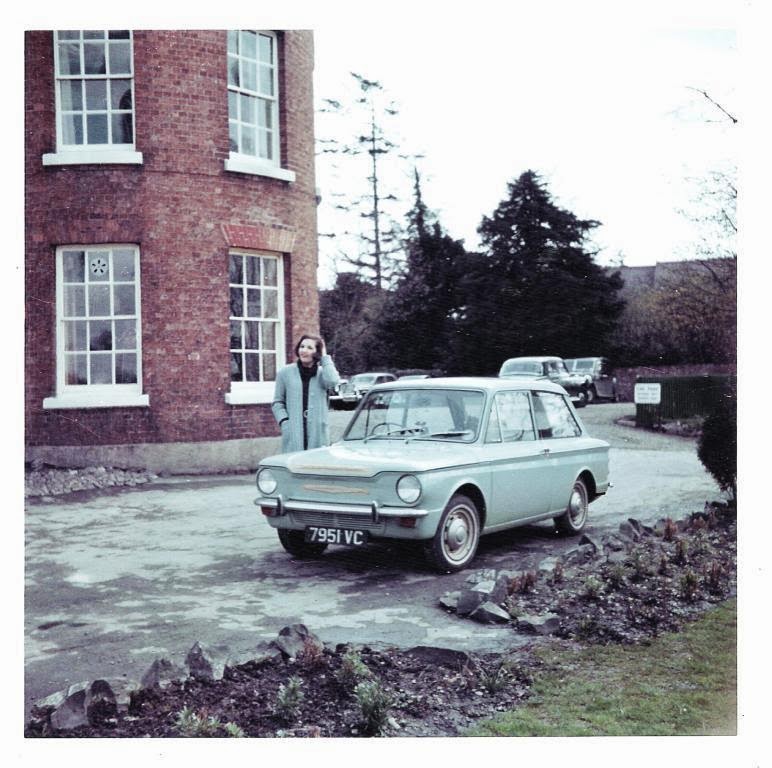
No Bristols please. Except for the BMW-based 400 and the beautiful 404 they were heavy and lugubrious. I never went for the mystique so assiduously promoted by writers like the matchless Leonard Setright. Triumph Stag? I thought it was rubbish when I went on the press launch. Hillman Imp? I owned one and when it went it was OK; I drove it to Maranello where I had lunch with Enzo Ferrari, but it was not made very well. Same goes for any Avenger, even the Avenger Tiger. The press launch was on Malta where we couldn’t drive them far enough to grow suspicious of unreliability. The Morgan 3 wheeler or Plus 4 were fine, but the Plus 8 was where Morgan began to lose its way and power outstripped handling. I wouldn’t include a Delorean in any list except perhaps one on how not to develop a sports car. It was terrible. Reliant Scimitar? A definite maybe. Triumph TR5 - not bad until they put a wiggly independent back-end on making it pitch and curtsy. Triumph 1300 absolutely not. And why relegate the MGA to 95th? Shame
Range Rover. Deserves its place. Took this on the press launch by Goonhilly Down, 1970.


Love lists
Hillman Imp. On road test for The Motor with Penny Duckworth by door. Pre-launch picture so badges taped over.

100.Range Rover Evoque 99. Ginetta G40R 98. Vauxhall Astra 97. Marcos TSO 96. Honda Civic 95. MGA 94. Vauxhall Chevette HSR 93. Triumph Dolomite Sprint 92. Allard J2 91. Honda Jazz 90. Sunbeam Tiger 89. Nissan Juke 88. Invicta Black Prince 87. Noble M12 86. Lotus Carlton 85. Caterham Seven 160 84. Caparo T1 83. Rolls-Royce 10 HP 82. Triumph TR5 PI 81. Radical RXC 80. Triumph 1300 79. Daimler SP250 Dart 78. Morgan 4/4 77. Renault Megane RS 225 76. Noble M600 75. Lotus Sunbeam 74. Morgan Plus 8 73. BAC Mono 72. Gordon-Keeble 71. Austin-Healey Sprite 70. MGB GT 69. Bristol Fighter 68. Ford Cortina 1600E 67. Bowler EXR 66. AC Ace 65. Rolls-Royce Silver Shadow 64. Austin FX4 63. Napier-Railton 62. Caterham Supersport 61. Triumph 2000 60. Jaguar F-type 59. Morgan 3-wheeler 58. Reliant Scimitar 57. TVR Sagaris 56. Ford Escort RS2000 55. Bentley Continental GT 54. Ford Capri RS3100 53. Delorean DMC-12 52. Aston Martin V8 51. Ascari KZ1 50. Aston Martin V12 Vantage S 49. Subaru Impreza WRC 48. Hillman Avenger Tiger 47. Triumph Stag 46. Hillman Imp 45. Lister Storm 44. Rover P5B 43. Lotus Evora 42. Rover P6 3500S 41. Nissan Qashqai 40. Ariel Atom 39. Vauxhall Prince Henry 38. Aston Martin One-77 37. Rover 75 36. Jaguar XJ 35. Austin Seven 34. Bristol Blenheim 33. Lotus Cortina 32. Austin-Healey 3000 31. Aston Martin Vanquish 30. Lotus Seven 29. Land Rover 28. Jensen-Healey 27. Lotus Esprit 26. MG Midget 25. McLaren 12C 24. Morris Minor 23. Lotus Elan 22. TVR Speed 12 21. Rover SD1 20. TVR Chimaera 19. BMW Mini 18. Bentley Blower 17. Jaguar XF 16. Ford GT40 15. Rolls-Royce Phantom 14. Lotus Elise 13. Jaguar D-type 12. Ford Sierra RS Cosworth 11. Jensen FF 10. Ford Escort Mexico 9. TVR Griffith 8. Aston Martin DB5 7. Jaguar XJ220 6. McLaren P1 5. Yamaha MOTIV.e 4. Range Rover 3. Jaguar E-type 2. McLaren F1 1. original Mini

Works Austin-Healey 3000 rally car test. I am the fresh-faced youth.

Sunday, 4 May 2014

Rolls and Royce

Inseparable as Gilbert and Sullivan or Victoria and Albert, Rolls and Royce created the world's most recognisable brand name 110 years ago, Wednesday 4 May 1904. They met at the Midland Hotel Manchester not only producing “The Best Car in the World” (Rolls-Royce was never modest), but aero-engine excellence throughout the Second World War and ever since.
Right: Merlin in a Spitfire.
Only a little of the credit belonged to The Hon Charles Stewart Rolls, (below) an Edwardian gentleman to his elegant fingertips, complete with uniformed chauffeur and mechanic, but famously stingy. The late Sir Thomas Sopwith described him as, “curiously unlovable.” Rolls felt he had little to learn from Royce, a northern engineer, a crane manufacturer with an infinite capacity for taking pains. But as an ardent balloonist and aerial adventurer Rolls’s lifestyle was expensive, and the sales company set up with £6,500 from his father, Lord Llangattock, needed a new line to augment his imported French cars. Flying exploits were his undoing. Rolls achieved the melancholy distinction of being the first pilot killed in a British air crash at Bournemouth on 2 June 1910.
Workaholic, obsessive, sickly Frederick Henry Royce’s pursuit of perfection knew no bounds and, ill from overwork, he dismantled his Decauville to make it function properly. It was a car, he concluded, “...marred by careless workmanship,” so he set about designing something better. The result was an experimental car Rolls drove out of the Midland Hotel's carriage court (demolished in the 1930s to make way for a reception area) and realised that this 2-cylinder was as smooth and quiet as a 4-cylinder. Rolls instructed his partner, Claude Johnson to take on the Royce car, and negotiate for C S Rolls & Co (Royce below)to have exclusive rights.
The great engineer and the parsimonious aristocrat signed their agreement on December 23, 1904. Claude Johnson thought double-barrelled names had a ring to them, and made his contribution to the motoring lexicon, inserting a clause stipulating that the cars would henceforward be known as Rolls-Royces.
Later one of the 40/50 cars was painted silver and called The Silver Ghost. It was the fashion to apply names to individual cars, rather like ships. The title stuck, and the Silver Ghost remained in production for eighteen years. Phantoms, Wraiths, Shadows and Spirits followed. Rolls-Royces were always beautifully made although scarcely inventive, and never above taking somebody else's component (an automatic transmission from General Motors, or a patent suspension from Citroën) and adapting it to its own exacting standards. An engine from Munich, transmission from Friedrichshafen, even an aluminium body from Dingolfing, has not been entirely out of character.
In 1914 the Admiralty instructed Lieut Walter Owen Bentley of the Royal Naval Air Service to find out why its new French aero engines were overheating. By 1916 he had designed one himself the Bentley rotary (below), which saw service in Sopwith Camels, and was used by the RAF until 1926.
After the war Bentley wasted no time getting into car production. His 3 Litre appeared at the London Motor Show in 1919, yet the foundations of the Bentley legend were laid at the Le Mans 24 Hours race in France. Bentleys won it five times against opposition from Mercedes-Benz, Alfa Romeo, and Bugatti, but following the 1929 depression even the extravagant Bentley Boys had to economise. In July 1931 Bentley Motors called in the receiver.
Napier had not made a car since 1925, it was now predominantly an aero engine manufacturer, but was so impressed with the new 8 Litre opened negotiations to buy Bentley Motors. In September The Autocar confidently announced that an agreement only awaited formal approval. The receiver called for sealed bids, but the mysterious British Central Equitable Trust dashed Napier’s hopes. Weeks later the subterfuge was revealed. Rolls-Royce, learning of Napier's interest, had pre-empted its rival.
Bentley never forgave what he regarded as Rolls-Royce's deceit, and although he joined Bentley Motors (1931) Ltd soon left, forbidden from ever applying his name to a car again.
In 1933 Rolls-Royce announced the Derby-built Silent Sports Car, and with a few memorable exceptions, Bentleys became little more than badge-engineered Rolls-Royces. The exceptions included the splendid Continentals of the 1950s, with sweeping lines inspired by a contemporary Buick, and the new Continental developed by the VW-owned company. More in The Complete Bentley, Dove Publishing Ltd. (right, WO Bentley bust at Bentley Motors, Crewe)

Tuesday, 18 March 2014

Roger Crathorne and Land Rover

Roger Crathorne had already been with Land Rover 16 years when I met him on a windy hill in Kintyre. The best Land Rover driver in the world, he was there to endorse a full page advertisement in the Daily Telegraph claiming you could drive across the peninsula. I had failed. Crathorne’s assignment was to show how.
Roger now says he is retiring. It is surprising how much an individual can influence a company culture. Lotus had Colin Chapman. MG had Cecil Kimber. Rover had a handful of Wilkses; Jaguar Sir William Lyons and Bentley WO. Test and development driver, engineer, the cross-country pre-eminence of Land Rovers and Range Rovers owes everything to his skill and (I do not exaggerate) devotion. He has achieved it, furthermore, while remaining one of the most courteous approachable and unostentatious individuals in an industry where such virtues are rare. I was honoured when he agreed to a foreword in the 65th anniversary edition of my Land Rover book.
There are not many jobs-for-life these days, but it has been my luck to have had one of them. Land Rover has been my career; I have loved every minute of it, so I am delighted to introduce a new updated edition of a book that details what has been, in effect, my life’s work. Fittingly it celebrates 65 years of Land Rover and my 50 years with the company, describing every phase, every up-and-down and every important product to bear the name. The story of a stop-gap model that became a world wide success has been told in hundreds of books, some written not only about one model or series, but just about one particular car. The Land Rover File covers the entire span in one work of reference that answers most of the questions people ask. Departments and executives inside Land Rover rely on what Eric Dymock and his researchers have chronicled so as an independent author, we may not agree with him on absolutely everything. We use this book as a working document and I commend it as objective, truthful, packed with good pictures and down-to-earth detail. Roger Crathorne: Enthusiast and Technical PR Manager.
Retire? It is not in Roger’s nature. He will be fettling his own classic Land Rover. He will be advising, consulting in his quiet-mannered way. Royce was lucky to have Rolls for the practicalities, to perfect the imperfect, to work out ways and means. Land Rover was just as lucky to have Roger Crathorne.
Longest employee in the oldest Land Rover Roget Crathorne in HUE 166 (top) And with the Best 4x4s he created.

LinkWithin

Related Posts with Thumbnails